|
|
|
|
|
Basic Surf Fishing Tackle and
Rigging |
|
Back to Surf Fishing Homepage and Main
Menu |
|
Rod and Reel |
|
|
|
  Just
about any 6-7 foot rod from the 8-12 lb test
range can catch fish in the surf on a nice
fairly calm day. Many times whiting and
other species are feeding just off the shore
in a trough that typically forms between the
shorebreak and the first sandbar maybe 30
yards offshore and the required weight
needed to hold the rig in place is a 1 ounce
pyramid weight. I have fished like that for
years and still do because I do catch fish.
In fact, if you are going to throw 1/4 ounce
pompano jigs tipped with shrimp into the
nearshore trough just off the shorebreak for
pompano and whiting, you can use the same 7
foot spinning outfit with 8 to 12 lb test
described for use in the lagoon section of
this website very effectively. It's also
great for using a small silver spoon when
the glass minnows are in close and schools
of spanish mackerel or bluefish are hounding
them. Great light tackle sport! Just
about any 6-7 foot rod from the 8-12 lb test
range can catch fish in the surf on a nice
fairly calm day. Many times whiting and
other species are feeding just off the shore
in a trough that typically forms between the
shorebreak and the first sandbar maybe 30
yards offshore and the required weight
needed to hold the rig in place is a 1 ounce
pyramid weight. I have fished like that for
years and still do because I do catch fish.
In fact, if you are going to throw 1/4 ounce
pompano jigs tipped with shrimp into the
nearshore trough just off the shorebreak for
pompano and whiting, you can use the same 7
foot spinning outfit with 8 to 12 lb test
described for use in the lagoon section of
this website very effectively. It's also
great for using a small silver spoon when
the glass minnows are in close and schools
of spanish mackerel or bluefish are hounding
them. Great light tackle sport!
However,
if you do enough surf fishing there will
come that day when a school of 50 lb tarpon
or other gamefish come busting through a
school of mullet 40 yards beyond your
maximum casting range, and the "real" surf
fishermen with real surf rods will be having
the time of their lives while you stand
there holding your little stick. Or the
pompano that day may be feeding beyond that
first offshore sandbar and if you attempt to
cast there, you land instead on top of the
bar. Not where you really want to be. Again
the fish will be out of your range. Then
there are days when the surf is fairly rough
and the side currents are sweeping through
the inner trough and washing all but the
heaviest rigs right up on the beach, but the
fish are still there and the smaller rods
just can't handle the weight required to
keep your bait in the water for any length
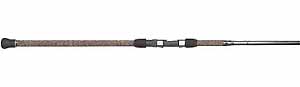
of time. A good quality surf rod is designed
to handle the sometimes extreme environment
of surf fishing (sand, salt spray, etc). It
is also designed to cast the heavier weight
lures and rigs designed for fishing the
surf. In addition it will have a longer butt
section to allow for the wider hand
placement required for distance casting and
a medium to fast action. A 9 to 10 foot rod
rated for 12 to 20 lb test line and a lure
weight of 1-4 ounces, matched with a good
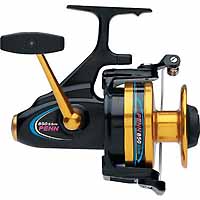
quality spinning reel such as a Penn
Spinfisher model 650ssm loaded with 250
yards of 15 lb test is a good start and will
handle most of the conditions you will find
while fishing for everything from whiting,
pompano, bluefish, to snook and redfish
along with many other species that patrol
the shorebreak and just beyond the first
bar.
For a
little more reach, go to a 11 to 12 foot rod
rated for 15 to 40 lb test and lure weights
of 3 to 8 ounces. Match this with a Penn
Spinfisher 850ssm or 950ssm filled to
capacity with 20 lb test and with practice
and the right casting action, you can throw
your rig quite far, which may make the
difference if tarpon, snook, jacks, or other
gamefish are busting into schools of mullet
just outside of your casting distance with
the 9 ft rod.
Note;
Understand that the above reccomendations
are based on my experience alone regarding
Penn Reels. I have used them for years and
for the most part they have served me quite
well. There are some other fine quality reel
makers out there. Many of the opinions I
have heard about the Shimano and the Okuma
line of reels sound very interesting. Also,
if you decide to really get serious about
surf fishing, you will find that different
rods of the same length will have different
actions or how they react to a force on the
line. A medium action rod will bend evenly
from about the halfway point all the way out
to the tip under stress of casting and
playing a fish while a faster action will
concentrate the bend more at the tip, which
may be better if using artificials. There is
a great Florida surf fishing forum at
Florida Surf Fishing.com where
you can ask questions and learn from some of
the best surf anglers in the state, and its
free to join.
|
|
|
|
|
|
Surf
fishing with bait requires a bit more
rigging than fishing the lagoon or
freshwater. This is due to the fact that you
will almost never be surf fishing without
wave action on the beach and you will soon
find your rig being washed up on the shore
before the fish you are seeking can find it.
Even if it doesn't wash up it will be moving
all over the place making it difficult to
detect a strike. For this reason a pyramid
sinker is all but mandatory. There are
exceptions to this when the mullet are
running along the beach and the larger
gamefish in the area are in hot pursuit but
that will be discussed later in this
section.
First we
will discuss the required terminal tackle
for fishing for two of the three most
popular surf caught species in this area,
pompano and whiting, then later on this page
we will cover bluefish, Spanish mackerel,
and larger game species such as snook,
tarpon, jacks, etc.
|
Rigging for Pompano, Whiting,
Margate, Croaker, Other Bottom Feeders.
|
Jump to;
Rod and Reel |||
Bait and Terminal Tackle
|||
Rigging for
Pompano , Whiting |||
Rigging for Blues,
Spanish Mackerell |||
Artificials for Blues
, Spanish Mackerell
|||Snook
, Tarpon, other large gamefish
Back to
Top |
 Sinkers;
A pyramid sinker is so called because it is
shaped like an upside down pyramid when
attached to your line and will work very
well in areas with a sandy bottom like most
of the Space Coast beaches. After the cast
it will drop through the water column and
anchor itself in the sand. This will allow
you the chance to take up the slack and feel
a bite. They come in sizes from 1-6 ounces
or more. I usually use the smallest pyramid
sinker that will keep the rig on the bottom
with my line tight enough to feel a strike.
This will be based on three things, casting
distance desired, wave conditions and the
pound test rating of the line you are using.
On many of our beaches the fish are not
really that far out, feeding within a trough
that forms just beyond the shorebreak at
high tide, but the heavier the line you are
using combined with the wave action can also
dictate weight requirements, as heavier
line, being thicker, provides more
resistance to wave action. If fishing with
lighter line of about 12 lb test in fairly
calm conditions, start with a one ounce
sinker. With 20 lb test, 2 ounces, and work
from there. Sinkers;
A pyramid sinker is so called because it is
shaped like an upside down pyramid when
attached to your line and will work very
well in areas with a sandy bottom like most
of the Space Coast beaches. After the cast
it will drop through the water column and
anchor itself in the sand. This will allow
you the chance to take up the slack and feel
a bite. They come in sizes from 1-6 ounces
or more. I usually use the smallest pyramid
sinker that will keep the rig on the bottom
with my line tight enough to feel a strike.
This will be based on three things, casting
distance desired, wave conditions and the
pound test rating of the line you are using.
On many of our beaches the fish are not
really that far out, feeding within a trough
that forms just beyond the shorebreak at
high tide, but the heavier the line you are
using combined with the wave action can also
dictate weight requirements, as heavier
line, being thicker, provides more
resistance to wave action. If fishing with
lighter line of about 12 lb test in fairly
calm conditions, start with a one ounce
sinker. With 20 lb test, 2 ounces, and work
from there.
|
|
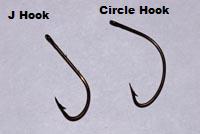 Hooks;
I use two different hooks for surf
fishing depending on the primary target(s). Hooks;
I use two different hooks for surf
fishing depending on the primary target(s).
If Pompano are the primary target,
and they are running strong use a size
1/0 circle hook. Pompano typically are
cruising along the beach faster than the
other species caught with the bottom rig and
take the baits at a faster rate in order to
keep up with the school. These hooks help to
reduce gut hooking and actually have a
higher hookup ratio than a regular "J" style
hook. The secret to using circle hooks is to
not "set" the hook with a sharp pull during
a strike like you would a "J" hook. Pressure
on the line as the fish grabs the bait and
tries to swim off will usually set the hook
for you.
If Whiting is the primary target,
or the surf fishing is more of a mixed bag
with margate, croakers and other bottom
feeders in the mix, use a standard #2
size "J" style hook. For these species I
believe a circle hook offers no real
advantages as these fish tend to be more
"stationary" feeders, or feed at a slower
pace. You will have to "set" the hook for
these species with a sharp upward sweep of
the rod tip as you feel them on the bait.
Using this type of hook does not stop you
from catching pompano, it just that when
using a circle hook during a pompano run you
will have a higher hookup ratio for pompano,
but a lower one for the whiting and other
species. Just below is a series of step by
step instructions for making a standard
pompano or whiting surf fishing rig and
works well with both hook styles.
|
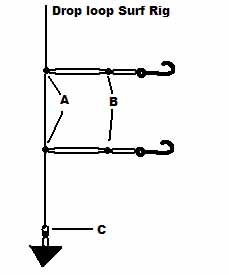 This
rig requires one or two hooks, based on your
preferences, and a pyramid sinker. For
pompano, whiting and most of the other
species you will likely catch using baits
for these species a leader is not usually
required so it can be tied directly on the
end of the fishing line. It consists of one
or two dropper loop knots (A) positioned
about 12 inches apart with the lower one
being about 12 inches above the weight. End
loops (B) compress the dropper loop and help
to secure the hook, while the weight is tied
on with an improved clinch knot (C). You can
also tie a snap swivel in place of the
weight and attach the weight with the snap
to allow for faster weight changes. The
knots for the dropper loops (A) should be
spaced about 12 inches apart and the bottom
one about twelve inches from the weight when
finished. With practice this can be rigged
in about a minute or so. Instructions for
each knot are just below and I find it
easier to do if the weight (C) is tied on
first. This
rig requires one or two hooks, based on your
preferences, and a pyramid sinker. For
pompano, whiting and most of the other
species you will likely catch using baits
for these species a leader is not usually
required so it can be tied directly on the
end of the fishing line. It consists of one
or two dropper loop knots (A) positioned
about 12 inches apart with the lower one
being about 12 inches above the weight. End
loops (B) compress the dropper loop and help
to secure the hook, while the weight is tied
on with an improved clinch knot (C). You can
also tie a snap swivel in place of the
weight and attach the weight with the snap
to allow for faster weight changes. The
knots for the dropper loops (A) should be
spaced about 12 inches apart and the bottom
one about twelve inches from the weight when
finished. With practice this can be rigged
in about a minute or so. Instructions for
each knot are just below and I find it
easier to do if the weight (C) is tied on
first.
|
The
Improved Clinch Knot (C above) is a real
basic knot used to tie hooks, swivels,
weights, etc. to the end of the line whether
fishing in freshwater for bass and bluegill,
or in the lagoon for reds and trout. I don't
use it for artificial lures because it
impedes the action of the lure too much.
When surf fishing I use it to tie pyramid
sinkers to form the bottom of a surf rig. As
mentioned above, I find it easier to start
here first, then work your way up.
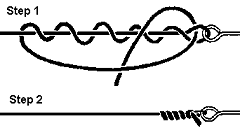 Step
1. To tie it, just put the end of the line
through the eye of the hook or lure about
eight inches, then while holding the line on
both sides of the hook with one hand, twist
the hook or lure about eight times. Then put
the end of the line through the little loop
of line just above the hook and route it
through the upper loop you just formed. Step
1. To tie it, just put the end of the line
through the eye of the hook or lure about
eight inches, then while holding the line on
both sides of the hook with one hand, twist
the hook or lure about eight times. Then put
the end of the line through the little loop
of line just above the hook and route it
through the upper loop you just formed.
Step 2. Pull the line
leading back to your pole to tighten.
|
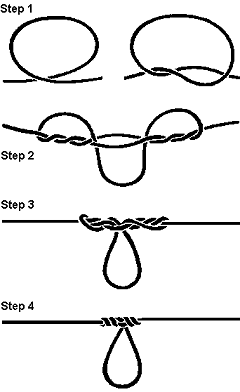
The
Dropper Loop
To make a drop loop, after attaching a
pyramid sinker to the end of your line using
the improved clinch knot above, Grab a the
line about 1 foot above the sinker with your
right hand and another section about 1 1/2
feet above your right hand with your left.
Step
1. Bring them together so that the line
between your hands form a loop.
Step
2. Then using your index fingers to keep
a small separation between the lines twist
the lines around each other three or four
times and put the loop you have formed
between the separation at your index
fingers.
Step
3. Using your third hand, (mouth, big
toe, whatever) keep the loop from pulling
back through the separation while using your
real hands to pull outward, tightening the
knot.
Step
4. The resulting loop should be about 6
to 8 inches in diameter. Grab the base of
the loop (near the knot) between you thumb
and index fingers and run them outward along
the loop compressing it. Once you have found
the true end of the dropper you are ready to
make the end loop (below) to attach the
hook. If you wish to make a two hook rig,
repeat steps 1-4 about 12 inches above the
first dropper.
|
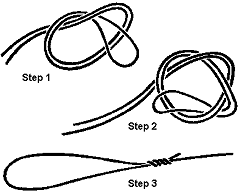
The
End Loop is used to keep the larger drop
loop somewhat compressed while you fish.
Step 1.
Bring the end of the drop loop around and
over the rest of the drop and through the
resulting loop. Don't tighten it but
position the new loop so the knot will be
about 2 inches from the end.
Step 2. Put the end
through the loop again.
Step 3. Hold the
dropper on either side of the knot and pull
apart to tighten.
To attach the hook,
compress the end loop, put it through the
eye of the hook, then spread the loop and
put entire hook through the loop, pull line
to tighten. One advantage of this rig over
most pre-made rigs from a tackle shop is
that changing the hook for the species
available is easy. Simply push the loop back
through the eye of the hook, loop the line
from over the hook and replace with the
another hook.
|
Fishing the Coquina Ridges; When fishing
from Patrick Air Force Base south to
Indialantic, you will encounter coquina
ridges that form a reef structure. These
areas are harder to fish due to the high
probability of snagging on the rocks but can
be worth the effort. These ridges and the
Sabellariid Worm Reefs that form upon them
can greatly increase the variety of fish
found in the area. Margates, whiting,
pompano, croakers, sailers choice,
sheepshead, black drum, redfish, and snook
all patrol these ridges looking for smaller
fish and crustaceans that hide among the
ridges just like they would a coral reef.
Many of these ridges will be exposed at low
tide (If they haven't been covered by
truckloads of sand during beach
re-nourishment projects). The Bank Weight
Rig, (pictured below) will decrease the
probability of snagging, but will not
entirely eliminate it. It can be made using
the instructions for the pyramid sinker rig
(above) simply by replacing the pyramid
sinker with a bank sinker (below). However,
there is an option that will negate the need
to replace the entire rig should the sinker
become snagged in the rocks. You can also go
to using lighter wire hooks. That way if the
hook snags on something you may be able to
pull hard enough to straighten the hook out,
pulling your rig free. Then you can restore
the bend with a pair of pliers and continue
fishing.
|
|
  To
make a Sinker Break away option for a bank
weight surf fishing rig you need four items.
First of all you need a small spool of cheap
fishing line that tests less than the line
spooled on your fishing reel. For instance
if you are fishing with 20 # line, get a
small cheap spool of 12 # line. The other
three items are a bank sinker (far left), a
three way swivel (near left), and a hook. To
make a Sinker Break away option for a bank
weight surf fishing rig you need four items.
First of all you need a small spool of cheap
fishing line that tests less than the line
spooled on your fishing reel. For instance
if you are fishing with 20 # line, get a
small cheap spool of 12 # line. The other
three items are a bank sinker (far left), a
three way swivel (near left), and a hook.
|
|
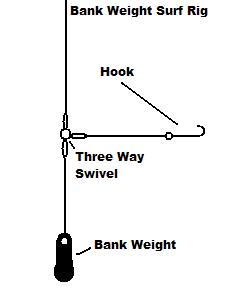 Step
One; Trim a 16 inch length of fishing
line from your reel and tie to one eye of
the three way swivel. Step
One; Trim a 16 inch length of fishing
line from your reel and tie to one eye of
the three way swivel.
Step Two; Trim a 20 inch length of
line from the lighter test spool of leader
material, tie this to another eye of the
swivel.
Step Three; Tie the third eye of the
swivel to your fishing line from reel.
Step Four; Tie a bank weight to the
other end of the lighter line from step two.
Step Five; Tie hook to the other end
of the heavier line
|
|
Interesting note; Recently at Playalinda
Beach at Canaveral National Seashore, it was
a very calm day and low tide. I decided to
fish with my 7 ft 8 lb test rig. Even though
the bottom was sand where I normally use a 1
ounce pyramid sinker, I used instead a 1
ounce bank sinker as I didn't really need
the holding power of a pyramid. At the first
tap of a whiting or croaker hit, I would
begin reeling slowly, dragging the rig along
the bottom, and continue until I felt the
firm pull of a fish on the line. I didn't
have to set the hook once and caught almost
every fish that hit. |
|
Baits; Now that
your surf rod is rigged, you are ready to
bait the hooks and cast out. For pompano,
whiting, croaker, margate, black drum, etc.
fresh cut shrimp, fresh caught sandfleas,
and fresh cut clams all work. Its easiest to
just buy a package of frozen shrimp and they
do work but fresh live shrimp is better if
the fish are being finicky. Cut the shrimp
into pieces about the size your index finger
from the tip to the first knuckle and string
a single piece on the hook.
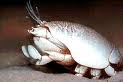 Die
hard pompano fans swear by sandfleas (mole
crabs) fresh caught at the shoreline of the
beach, after all, its why the pompano are
there in the first place. Bait shops do sell
frozen sand fleas but fresh is definitely
better and they aren't hard to catch. Stand
at the waters edge where the waves rush up
the sand after they break on the beach. As
the break water recedes back into the sea a
colony of sand fleas will reveal themselves
by leaving a patch of tiny V shaped ripples
in the water with the point of the V in the
direction the water is coming from. Check
this out and upon closer inspection you will
see what looks like little antenna
protruding up from the sand. Get too close
and they will disappear into the sand. The
sandfleas are buried just under the sand
with filter feeding apparatus extending up
into the water catching microorganisms for
food. Back off and let the next wave come
in. As it washes out and the patch
reappears, rush in, scoop up as much sand in
your hands as you can and throw it up on the
beach. If successful you will see these guys
scurrying around and trying to dig back into
the sand. Grab them (they can't hurt you, no
pinchers) and place them in a bucket with
some water and sand. Die hards use a device
called a
sand flea rake which is a
rectangular wire mesh basket attached to a
pole with a blade along one edge for digging
into the sand. They pull this like a hoe,
filling up the basket with sand which washes
through the mesh, leaving the crabs. Another
option is to use a plastic 5 gallon bucket
with many 1/4 inch diameter holes drilled
into the bottom and lower sides. With a
shovel, scoop sand into the bucket and then
lower the bottom of the bucket into the
water to strain the sand. Once you have
enough to fish with, insert the hook through
the top of the shell near the back of the
crab and thread the point forward into the
body. Die
hard pompano fans swear by sandfleas (mole
crabs) fresh caught at the shoreline of the
beach, after all, its why the pompano are
there in the first place. Bait shops do sell
frozen sand fleas but fresh is definitely
better and they aren't hard to catch. Stand
at the waters edge where the waves rush up
the sand after they break on the beach. As
the break water recedes back into the sea a
colony of sand fleas will reveal themselves
by leaving a patch of tiny V shaped ripples
in the water with the point of the V in the
direction the water is coming from. Check
this out and upon closer inspection you will
see what looks like little antenna
protruding up from the sand. Get too close
and they will disappear into the sand. The
sandfleas are buried just under the sand
with filter feeding apparatus extending up
into the water catching microorganisms for
food. Back off and let the next wave come
in. As it washes out and the patch
reappears, rush in, scoop up as much sand in
your hands as you can and throw it up on the
beach. If successful you will see these guys
scurrying around and trying to dig back into
the sand. Grab them (they can't hurt you, no
pinchers) and place them in a bucket with
some water and sand. Die hards use a device
called a
sand flea rake which is a
rectangular wire mesh basket attached to a
pole with a blade along one edge for digging
into the sand. They pull this like a hoe,
filling up the basket with sand which washes
through the mesh, leaving the crabs. Another
option is to use a plastic 5 gallon bucket
with many 1/4 inch diameter holes drilled
into the bottom and lower sides. With a
shovel, scoop sand into the bucket and then
lower the bottom of the bucket into the
water to strain the sand. Once you have
enough to fish with, insert the hook through
the top of the shell near the back of the
crab and thread the point forward into the
body.
|
Fishing with this rig and feeling the strike;
It is important after you have cast your rig
into the surf to keep a tight line to detect
a strike. Many people use a sand spike which
is a hollow tube of PVC or metal sharpened
to a point on one end. Push or hammer the
sharpened end into the sand until it is
secure and the butt of a rod can be placed
in it. Other's prefer to hold the rod
themselves. Either way, the slack line after
the cast must be reeled in for you to have
any chance of detecting a strike. If holding
the rod, I will keep the index finger of my
rod hand on the line just in from to the
reel. As a wave rolls in you will feel the
line tighten as a wave rolls in, and then
relax after the wave has broken on the
beach. A strike will feel much different as
a series of sharp irregular "taps" on your
line. If using a sand spike, cast the line,
place the butt end of the rod into the
spike, then turn the reel handle to take up
the slack until the wave action can be seen
in the rod tip. You will see the tip bow to
each incoming wave and then straighten as
the wave crashes. A hit will result in the
rod bowing over with a distinct pulsating
action. If using the "J" hook, grab rod and
set the hook with a sharp upward or back
sweep of the tip. If it's a pompano on a
circle hook rig, fish is on.
|
 Pompano
Jigs; Pompano jigs can be very
effective for pompano and whiting.
Pompano jigs typically are round headed
with a relatively short bucktail or
nylon tail and come in sizes ranging
from 1/4 to 1/2 ounce. Tip the hook with
a small piece of cut shrimp and fished
with a standard 8 to 12 lb test spinning
outfit it will catch most of the species
that the above described surf rig can
catch. Cast and retrieve by bumping the
jig along the sandy bottom and it will
put up little puffs of sand, attracting
pompano. Pompano
Jigs; Pompano jigs can be very
effective for pompano and whiting.
Pompano jigs typically are round headed
with a relatively short bucktail or
nylon tail and come in sizes ranging
from 1/4 to 1/2 ounce. Tip the hook with
a small piece of cut shrimp and fished
with a standard 8 to 12 lb test spinning
outfit it will catch most of the species
that the above described surf rig can
catch. Cast and retrieve by bumping the
jig along the sandy bottom and it will
put up little puffs of sand, attracting
pompano.
|
|
|
Jump to;
Rod and Reel |||
Bait and Terminal Tackle
|||
Rigging for
Pompano , Whiting |||
Rigging for Blues,
Spanish Mackerell |||
Artificials for Blues
, Spanish Mackerell
|||Snook
, Tarpon, other large gamefish
Back to
Top |
For Bluefish, a
leader is essential. It is easiest to buy a
pre-made rig designed for them available at
virtually any local tackle shop. They will
include the hook(s) and have a snap at the
bottom for attaching a pyramid sinker. But
they can also be readily made. There are
several configurations that can be used, and
none of them are very difficult to make.
This is probably the easiest.
|
 Step
one; Slide a sinker slide onto the end
of your tag line (line from reel). This will
allow the attachment of the pyramid sinker
to your line. This also allows live bait, if
you decide to use it, to swim away from the
sinker if you provide some slack in your
line, to provide a more natural
presentation. Step
one; Slide a sinker slide onto the end
of your tag line (line from reel). This will
allow the attachment of the pyramid sinker
to your line. This also allows live bait, if
you decide to use it, to swim away from the
sinker if you provide some slack in your
line, to provide a more natural
presentation. |
 Step
two; Thread a small plastic bead that is
larger than the diameter of the plastic
sleeve of the sinker slide onto your tag
line. This is called a stopper bead. You
will want this between the sinker slide and
the hook rigging in order to ensure that the
sinker does not slide all the way down over
the hook leader and interfere with the bait. Step
two; Thread a small plastic bead that is
larger than the diameter of the plastic
sleeve of the sinker slide onto your tag
line. This is called a stopper bead. You
will want this between the sinker slide and
the hook rigging in order to ensure that the
sinker does not slide all the way down over
the hook leader and interfere with the bait. |
 Step
three; Tie the swivel end of a wire
leader snelled 3/0 hook, (Eagle Claw model
9140 Snell, size 3/0 hook is a good choice)
to tag line. Use an improved clinch knot
(above). The wire leader will prevent a
bluefish or other toothy fish from biting
through the line. While I normally
discourage the use of wire leaders for many
species, it doesn't seem to deter bluefish
at all. Step
three; Tie the swivel end of a wire
leader snelled 3/0 hook, (Eagle Claw model
9140 Snell, size 3/0 hook is a good choice)
to tag line. Use an improved clinch knot
(above). The wire leader will prevent a
bluefish or other toothy fish from biting
through the line. While I normally
discourage the use of wire leaders for many
species, it doesn't seem to deter bluefish
at all.
|
Step
four; Attach appropriate sized pyramid
sinker to snap on sinker slide. The sinker
(and the bead) should now be able to slide
away from the hook rig but not able to get
past the knot attaching the leader. I would
normally start with about a two to three
ounce weight and move up if conditions prove
to be too rough. You want to be able to keep
some tension on the line in order to detect
a strike without dislodging the sinker from
the sand. This sinker is designed to implant
itself into the sand after the cast in order
to provide holding power.
|
Step five;
Bait hook with cut mullet, finger mullet
(alive or dead) and cast into nearest ocean.
|
Additional Notes;
You can substitute a Berkely or other style
steel leader for the wire snell rig in step
three. These have a swivel on one end and a
snap on the other end. Use the snap to
attach a hook. If you go this route use a
size 3/O O'Shaughnessy style hook. I also
recommend a leader of at least 18 inches.
The pre-snelled wire leader hooks are a bit
better in my opinion because it reduces the
amount of visible terminal tackle in the rig
by one snap, making the leader a little
harder for wary fish to detect. This rig can
also be use to fish a live finger mullet
hooked just behind the dorsal fin and just
might be the difference on whether a Spanish
mackerel will hit the bait or not. Spanish
Mackerel will take live bait but only rarely
dead bait. They also prefer cleaner water
and are much warier than bluefish, which
will attack just about anything when in
feeding mode.
|
|
Artificial
lures for bluefish and Spanish Mackerel
|
Jump to;
Rod and Reel |||
Bait and Terminal Tackle
|||
Rigging for
Pompano , Whiting |||
Rigging for Blues,
Spanish Mackerell |||
Artificials for Blues
, Spanish Mackerell
|||Snook
, Tarpon, other large gamefish
Back to
Top |
For this section,
I've included both bluefish and Spanish
mackerel due to the fact that they will both
hit pretty much the same lures. If they are
in pretty close to shore the standard 8-12
lb test spinning outfit used in the lagoon
will be a great outfit for casting lures to
these species. Where I recommend a wire
leader for using bait for bluefish, I am
going to recommend about a two foot section
of 25 lb test monofilament for this type of
fishing. When using bait, the bluefish is
more likely to engulf the entire bait and
the leader will be in contact with sharp
teeth longer. With lures, the hookup is
faster and the body of the lure will take
the brunt of the abuse with the mono leader
providing extra insurance. Using a wire
leader with a lure will definitely cut down
on strikes, especially with the mackerel.
You still may lose a lure or two but that's
the sacrifice made for actually catching
one.
|
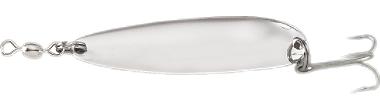 Krocodile
Spoon by Luhr Jensen; As
mentioned in the lagoon tackle section of
this website, the Krocodile Spoon is my all
time favorite lure and has been a consistent
producer for me since I moved to Florida in
1967. They come in a variety of sizes from
3/8 ounces to 1-1/2 ounces and my favorites
are the 3/8 and 1/2 ounce sizes used with 8
to 12 lb test line spinning tackle. Go with
larger surf tackle when using the larger
size lures. Retrieve these fast to imitate a
panicked baitfish and it will draw attention
and stimulate a chase response. Fast
predatory fish like bluefish, and Spanish
mackerel are used to having to chase down
their prey and when supposedly live prey
does not flee when they approach, they get
suspicious.) Krocodile
Spoon by Luhr Jensen; As
mentioned in the lagoon tackle section of
this website, the Krocodile Spoon is my all
time favorite lure and has been a consistent
producer for me since I moved to Florida in
1967. They come in a variety of sizes from
3/8 ounces to 1-1/2 ounces and my favorites
are the 3/8 and 1/2 ounce sizes used with 8
to 12 lb test line spinning tackle. Go with
larger surf tackle when using the larger
size lures. Retrieve these fast to imitate a
panicked baitfish and it will draw attention
and stimulate a chase response. Fast
predatory fish like bluefish, and Spanish
mackerel are used to having to chase down
their prey and when supposedly live prey
does not flee when they approach, they get
suspicious.)
|
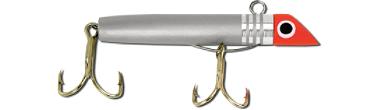 The
Got-cha jig by Sea Striker Lures has
long been a favorite for bluefish and
Spanish mackerel along Space Coast Beaches
and the inlet areas. Retrieve them with a
series of jerks with the rod. Comes in both
plastic (series 100) and metal (series 300)
bodies. Get the metal for greater
durability. Comes in both an undressed
version (shown) and a "dressed" version with
a bucktail rear end and a rigid mounted
single rigid mounted hook. The
Got-cha jig by Sea Striker Lures has
long been a favorite for bluefish and
Spanish mackerel along Space Coast Beaches
and the inlet areas. Retrieve them with a
series of jerks with the rod. Comes in both
plastic (series 100) and metal (series 300)
bodies. Get the metal for greater
durability. Comes in both an undressed
version (shown) and a "dressed" version with
a bucktail rear end and a rigid mounted
single rigid mounted hook.
|
|
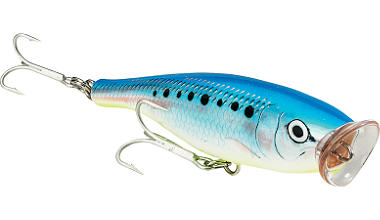 Rapala
Saltwater Skitter Pop; Cast into a
school of bluefish feeding on the surface
and this plug and other similar plugs like
the Mirrolure Popa Dog will almost certainly
draw a strike. Cast and retrieve with a
series of rod pumps to create a surface
commotion that will draw predatory fish from
a distance. Rapala
Saltwater Skitter Pop; Cast into a
school of bluefish feeding on the surface
and this plug and other similar plugs like
the Mirrolure Popa Dog will almost certainly
draw a strike. Cast and retrieve with a
series of rod pumps to create a surface
commotion that will draw predatory fish from
a distance.
|
Tackle for Tarpon, Snook in the Surf
|
Jump to;
Rod and Reel |||
Bait and Terminal Tackle
|||
Rigging for
Pompano , Whiting |||
Rigging for Blues,
Spanish Mackerell |||
Artificials for Blues
, Spanish Mackerell
|||Snook
, Tarpon, other large gamefish
Back to
Top |
|
Tarpon in the surf is some of the most
exciting fishing there is, as long as you
have the proper tackle. Of the three classes
of spinning rods described above you would
definitely want to use the larger 10-12 foot
rod and a reel filled to capacity with good
quality line. A tarpon is a big strong fish
and the fight will likely last a while if
you're lucky. Rigging is simple. To the tag
end of your line attach a strong barrel
swivel, and then about 6 ft of 80 lb test
monofilament shock leader. Attach a 6/0
circle hook to the end of the leader. Hook a
live mullet through the upper lip to allow
it to breath. A dead mullet will also
attract tarpon and can be hooked through the
eyes. Do not use a weight of any kind. When
hooked, a tarpon will jump, shaking his head
in an attempt to throw the hook. A weight
attached to the line will increase his odds
of doing so. When the jump occurs, bow the
rod to the fish. It will likely be too large
for you to throw off balance when he jumps
and keeping pressure on the line will give
the fish the advantage he needs, so as it
jumps, point the rod at the fish and reapply
pressure after the jump. Best fishing for
tarpon is during higher tidal phases that
coincide with first light. |
Snook
can often often patrol the surf and will
chase the mullet schools as they pass
through. They also have a fondness for live
croakers and as such, if you catch any on
your bottom rig you now have a great live
bait for snook. Fish either live mullet or a
live croaker on a size 4/0 circle hook tied
to at least a 40 lb test leader. This can be
fished with a sliding egg sinker. Just
thread a sliding egg sinker onto the tag
line, (line from reel) then follow it with a
small plastic bead. Then using an albright
knot attach the line to the leader. The
plastic bead should keep the sinker from
sliding all the way to the hook. If you wish
to try artificials try the previously
mentioned Krocodile Spoon or the Rapala
Skitter Pop mentioned for bluefish. Other
lures, some of which are listed below will
work as well. Snook fishing, like tarpon
fishing will be best at first light, and at
higher tides. The snook will be feeding in
the "trough" just outside the surf line.
|
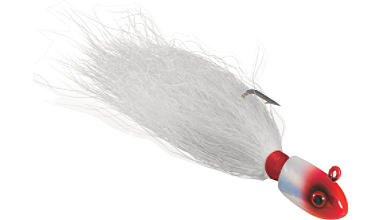 Bucktail
jigs have long been a standard for snook in
the area. Unlike using a jig head with
plastic tails, bucktail jigs have a
breathing action due to the hair of the jig
reacting to the water which can create a
lifelike look to a gamefish. The High Tide
B52 jig shown at left comes in sizes ranging
from 1/2 ounce all the way up to 6 ounces.
For snook in the surf, try anything from the
1/2 ounce to about 2 ounces. Some of the
best colors to try are are white, pink, and
chartreuse. Bucktail
jigs have long been a standard for snook in
the area. Unlike using a jig head with
plastic tails, bucktail jigs have a
breathing action due to the hair of the jig
reacting to the water which can create a
lifelike look to a gamefish. The High Tide
B52 jig shown at left comes in sizes ranging
from 1/2 ounce all the way up to 6 ounces.
For snook in the surf, try anything from the
1/2 ounce to about 2 ounces. Some of the
best colors to try are are white, pink, and
chartreuse.
|
|
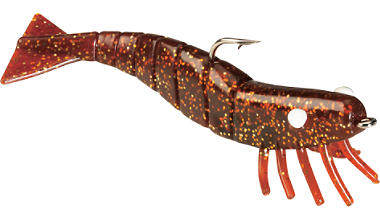 Snook
love jumbo shrimp and this is one of the
most realistic shrimp lures out there. While
for the lagoon I typically recommend the 3
inch model, here in the surf I would go with
either the 4 inch 1/2 half ounce model or
the 6 inch one ounce model. Comes in a
variety of colors, try the chartreuse or the
Root beer color. Snook
love jumbo shrimp and this is one of the
most realistic shrimp lures out there. While
for the lagoon I typically recommend the 3
inch model, here in the surf I would go with
either the 4 inch 1/2 half ounce model or
the 6 inch one ounce model. Comes in a
variety of colors, try the chartreuse or the
Root beer color.
|
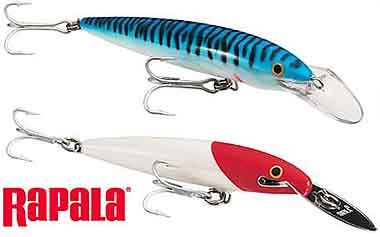 The
Rapala Magnum is one of the great all time
saltwater lures for large fish and come in
both sinking and floating diving models. The
floating model is 7 inches long, 1-1/2
ounces, and has a plastic lip. The sinking
models start at 4-3/8 inches in length (7/8
oz.) and range to 10-1/2 inches (4-1/2 oz).
I would recommend that for surf fishing, the
floating models would be the better choice,
especially if casting these over the coquina
ridges of the Satellite Beach, Indian
Harbour Beach and Indialantic areas. The
Rapala Magnum is one of the great all time
saltwater lures for large fish and come in
both sinking and floating diving models. The
floating model is 7 inches long, 1-1/2
ounces, and has a plastic lip. The sinking
models start at 4-3/8 inches in length (7/8
oz.) and range to 10-1/2 inches (4-1/2 oz).
I would recommend that for surf fishing, the
floating models would be the better choice,
especially if casting these over the coquina
ridges of the Satellite Beach, Indian
Harbour Beach and Indialantic areas. |
|
Back to Top |
|
|